I still remember that night shift clearly.
An aluminium plant. Peak summer. Machines running flat out.
A fitter suddenly collapsed near the conveyor line. People rushed in. Someone said it’s heat exhaustion. Another poured water on his face. One supervisor tried to make him sit up. No one checked breathing properly. The ambulance call was delayed because “sir is busy in meeting.”
By the time he reached the hospital, it was declared a massive cardiac arrest.
That one incident exposed everything—our gaps, our assumptions, and how fragile our so-called preparedness really was.
I’ve never looked at factory emergency SOPs the same way after that.
Why most workplaces are actually unprepared
On paper, most factories look excellent.
First-aid boxes ticked. Emergency numbers pasted on walls. Training attendance sheets signed and filed.
But when a real emergency hits:
- People panic and crowd the victim
- Supervisors freeze, waiting for instructions
- Trained first-aiders forget basic steps
- The OHC is locked, or the only staff is on break
Most workplaces prepare for audits. Very few prepare for that one unexpected moment at 2:30 a.m.
An SOP that works only during inspection is not an SOP.
It’s decoration.
What a medical emergency SOP should really achieve
Forget fancy language.
A real SOP should answer just one thing for any worker, supervisor, or security guard:
“If someone collapses right now, what exactly do I do in the next five minutes?”
If your SOP can’t guide those five minutes clearly, it will fail when it matters most.
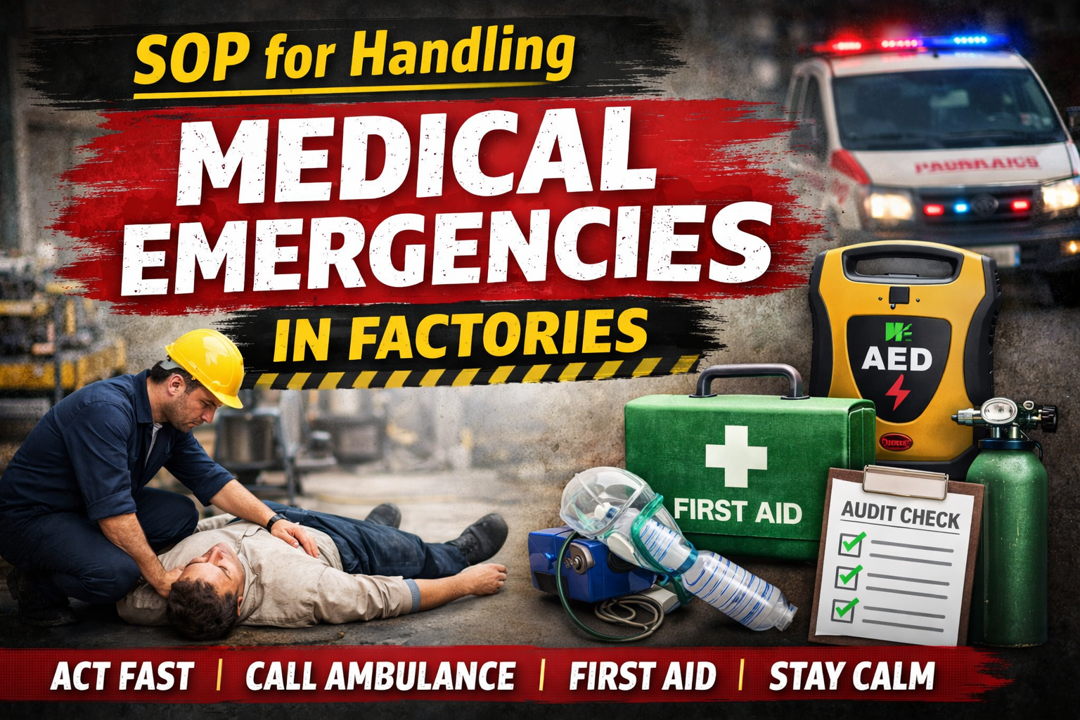
Step-by-step SOP for handling medical emergencies in a factory
Step 1: Make the area safe first (first 30 seconds)
Before touching the patient:
- Stop nearby machinery
- Isolate electrical panels or chemical sources
- Push people back and create space
I’ve personally seen helpers get injured because they rushed in without checking the surroundings.
One patient turning into two is the worst outcome.
Step 2: Quick basic check – nothing complicated
Keep it simple. This is not a hospital ward.
- Call out loudly and tap the shoulder
- Watch the chest—normal breathing or not
- Check pulse at neck or wrist if possible
If the person is not breathing or breathing abnormally, don’t debate.
Treat it as a medical emergency immediately.
Seconds matter here.
Step 3: Call for help immediately—no hesitation
This should happen at the same time, not after first aid.
- Inform OHC or on-duty pharmacist
- Call the factory ambulance
- Inform shift in-charge and safety officer
Assign responsibility clearly:
“You call ambulance. Now.”
Never assume someone else has done it. I’ve seen precious minutes lost because everyone assumed.
Step 4: Immediate first aid based on what you see
No textbook language. Only what works on the shop floor.
For sudden collapse / suspected heart problem
- Lay the person flat on a firm surface
- Start CPR if trained
- Use AED if available—don’t wait for a doctor
I’ve used AEDs in factories. They are meant for exactly this situation.
For heavy bleeding
- Apply direct pressure firmly
- Elevate limb if possible
- Do not remove stuck objects
Removing objects has caused fatal bleeding more than once.
For burns
- Cool the area with clean running water
- Remove rings, belts, tight clothing
- Never apply oil, powder, toothpaste
Yes, even today people still do this.
For chemical exposure
- Flush with plenty of water
- Remove contaminated clothing carefully
- Refer MSDS kept in OHC
This is why MSDS should not be locked inside a cupboard.
Step 5: Shift without delay—but properly
- Stabilise first, don’t overdo treatment
- Use stretcher or wheelchair
- Maintain airway while shifting
I’ve seen patients worsen not because of injury—but because of careless transport.
What an industrial first-aid room must actually have
Not items kept for show. Things that work when needed.
At minimum:
- Oxygen cylinder with mask (checked and filled)
- BP apparatus and thermometer
- Glucometer with working strips
- AED where workforce strength justifies it
- Doctor-approved emergency medicines
- Stretcher and wheelchair
- Eye wash facility
- Proper waste disposal
And one thing that matters more than equipment:
trained, authorised staff available—especially during night shifts.
A locked OHC during night duty is not negligence.
It’s an accident waiting to happen.
Role of pharmacist / OHC staff during emergencies
In factories, the pharmacist is often the first clinical responder.
Not just a dispenser of tablets.
During emergencies, the pharmacist:
- Takes charge calmly
- Guides first-aiders clearly
- Starts oxygen, CPR, glucose when indicated
- Coordinates with ambulance and hospital
- Maintains medicine control
- Documents the incident accurately
I’ve personally handled seizures, cardiac arrests, crush injuries—often before a doctor arrived.
Confidence, training, and presence of mind matter far more than labels.
Compliance and audit expectations in India
Indian laws are clear—emergency readiness is mandatory.
Key requirements include:
- Factories Act, 1948
- State Factory Rules for OHC staffing
- IS 2213 standards for first-aid boxes
- Regular mock drills
- First-aider training records
- Emergency incident documentation
Today’s auditors don’t just glance at registers. They ask practical questions:
- “Who handles emergencies at night?”
- “When was your last drill?”
- “Show the SOP used during actual incidents.”
The focus has shifted from paper to performance.
Do’s and Don’ts learned the hard way
Do
- Act quickly and decisively
- Speak calmly and give clear instructions
- Delegate tasks
- Document after stabilisation
Don’t
- Crowd the patient
- Delay ambulance for approvals
- Give food or water to unconscious patients
- Hide incidents to avoid reporting
Cover-ups always surface. And when they do, they create bigger problems than the incident itself.