A field-level view from inside Indian factories
I’ve spent close to a decade inside operating factories—alumina plants, manufacturing units, captive townships, and high-risk industrial environments. Not visiting them for audits, but working there every day. Running Occupational Health Centres. Managing pharmacy stores. Handling emergencies at odd hours. Sitting across the table from inspectors who don’t need explanations—they need clarity.
Over the years, I’ve realised something important.
Most organisations don’t fail medical compliance because they ignore the Factories Act.
They fail because they treat medical compliance as a checklist, not a living system.
On paper, everything looks fine.
On the shop floor, things don’t connect.
This article explains what the Factories Act medical requirements really mean in practice—how they work, where they break, and how to fix them without panic or overengineering.
This is written for HR teams, compliance officers, plant heads, and safety managers who want clarity, not legal noise.
Why medical compliance under the Factories Act carries more weight than people realise
Medical compliance is often seen as a “support function.”
Something necessary, but not core.
That assumption is risky.
From the regulator’s point of view, medical arrangements are one of the clearest indicators of how seriously an employer takes worker welfare. After any serious accident or occupational illness, medical records are usually examined before safety SOPs or training presentations.
Why?
Because medical systems show what actually happened—not what was planned.
A properly functioning medical setup demonstrates:
- Readiness before incidents occur
- Ability to respond when something goes wrong
- Evidence of care, not just intent
In several inquiries I’ve been part of, the strength or weakness of medical documentation quietly decided how harshly the organisation was viewed.
Medical compliance is not just statutory.
It’s reputational.
And in difficult situations, it becomes defensive.
What the Factories Act actually expects (without the textbook language)
The Act doesn’t expect factories to run hospitals.
What it expects is reasonable preparedness, proportional to:
- Workforce strength
- Nature of operations
- Level of risk
At a practical level, this translates into:
- An Occupational Health Centre where applicable
- Qualified medical personnel with defined availability
- First aid facilities matching workforce size and hazards
- Proper storage and control of medicines
- Medical examinations where exposure demands it
- Statutory records that are complete and meaningful
- Emergency response capability
The confusion usually starts when these elements are implemented independently, without coordination.
Compliance isn’t about having all components.
It’s about how well they work together.
Why audits fail in real factories (what we don’t say in meetings)
In my experience, audit failures are rarely dramatic.
There’s no total absence of facilities.
No complete negligence.
Instead, there are small cracks everywhere.
And inspectors are very good at finding cracks.
1. The OHC exists, but doesn’t function like one
Almost every factory has a room labelled “OHC.”
There’s a bed.
A BP instrument.
Sometimes even an oxygen cylinder.
But when inspectors start asking operational questions, things get uncomfortable.
Questions like:
- Who is available here during night shifts?
- When was the last emergency handled?
- What was done before referral?
Very often, the OHC has become a formality—opened when needed, otherwise silent.
A real OHC is not defined by furniture.
It’s defined by response capability.
Inspectors sense this difference within minutes.
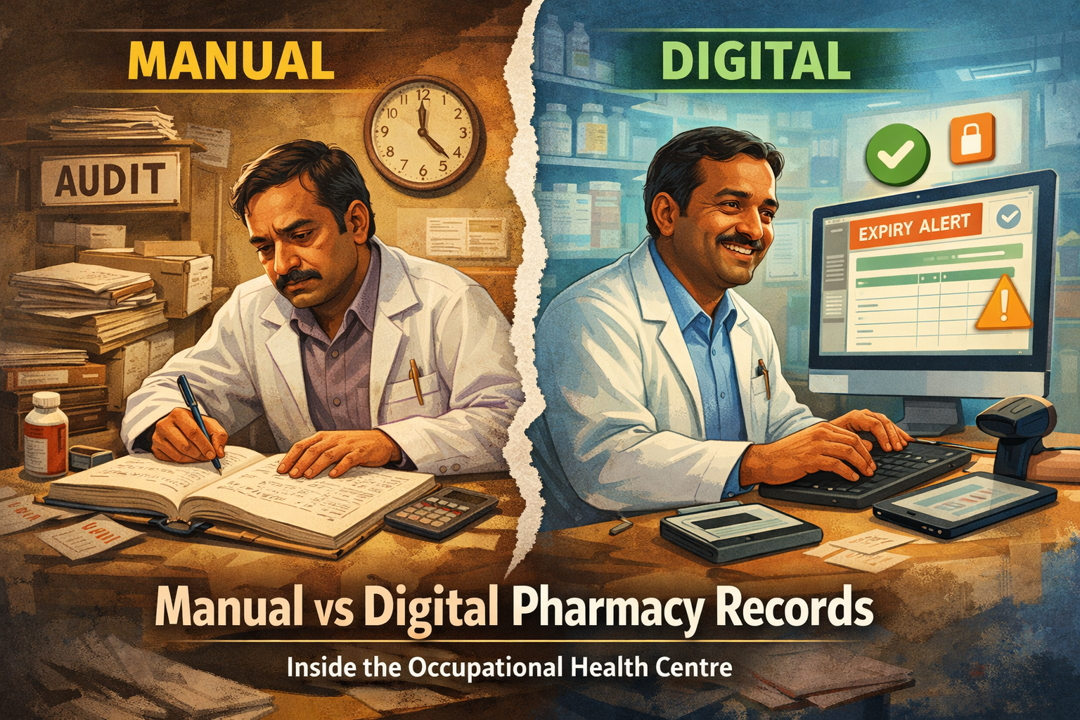
2. Pharmacy stock is present, but unmanaged
This is one of the most common and most damaging gaps.
Medicines are available. That’s not the issue.
The problem is:
- Expired and valid medicines stored together
- No clear segregation of emergency drugs
- No issue records
- No temperature monitoring for injectables
I once saw an audit turn tense because of a single expired vial picked from an emergency tray. Everything else became secondary after that.
Pharmacy discipline reflects medical seriousness.
Loose pharmacy control immediately weakens credibility.
3. First aid boxes are installed, not maintained
Factories often proudly point out the number of first aid boxes installed across departments.
Inspectors don’t count boxes.
They check:
- Whether contents are complete
- Whether someone knows how to use them
- Whether inspection is actually happening
The most common gap?
No one can confidently identify the trained first aider on a specific shift.
A first aid box without a trained person is just a cupboard.
4. Records are maintained, but don’t explain anything
This is subtle, but critical.
Registers are filled.
Columns are complete.
Yet, when someone tries to trace an incident:
- Treatment details don’t match accident records
- Follow-up is missing
- Decisions aren’t explained
Medical records are not just compliance documents.
They are narratives.
If the story doesn’t make sense, the organisation looks careless—even when it wasn’t.
Breaking medical compliance into practical operational steps
Instead of thinking in sections and clauses, it helps to think in daily workflow terms.
Step 1: Make the OHC function as a unit, not a room
A functional OHC should answer three simple questions at any moment:
- Who is responsible right now?
- What services are being provided here?
- What happens if a serious case arrives?
Practically, this means:
- Clearly displayed doctor and nurse availability
- Duty rosters that reflect reality
- A defined emergency escalation process
- Updated referral hospital details
The OHC should be capable of stabilising a patient, not just referring them out immediately.
That expectation is rarely written, but always assessed.
Step 2: Bring pharmacy under control, not just storage
Pharmacy management is often underestimated.
In practice, it should include:
- A doctor-approved medicine list
- Clear separation of OPD, emergency, and consumables
- Monthly expiry checks with disposal records
- Storage conditions monitored and recorded
- Issue entries linked to patients or incidents
When pharmacy systems are clean, audits usually flow smoothly.
When they’re messy, everything else comes under suspicion.
Step 3: Treat first aid as part of shift planning
First aid fails when it’s nobody’s responsibility.
It works when:
- First aiders are nominated shift-wise
- Training is refreshed, not forgotten
- Boxes are inspected regularly
- Usage is recorded and replenished
Well-managed first aid reduces lost-time injuries quietly, without announcements.
Step 4: Connect medical, safety, and HR instead of isolating them
This is where most factories lose value.
Medical data should inform:
- Safety risk assessments
- Ergonomic improvements
- Fitness and job placement decisions
- Absenteeism and health trend analysis
I’ve seen departments with repeated complaints of pain, dizziness, or irritation. The issue wasn’t worker weakness—it was exposure or workstation design.
Medical insights are preventive tools, if used properly.
Medical examinations: commonly misunderstood, often mishandled
In many organisations, medical examinations are treated as annual events:
- Camps conducted
- Reports received
- Files stored
But the real intent is risk-based fitness assessment.
This includes:
- Pre-employment medicals before deployment
- Periodic examinations linked to exposure
- Clear fitness opinions, not vague remarks
- Confidential handling of findings
Medical fitness is not about rejection.
It’s about protection—of the worker and the employer.
Records that actually protect the organisation
Here’s a hard truth learned from experience:
When incidents escalate, spoken explanations don’t survive scrutiny.
Written records do.
Good medical records are:
- Legible
- Consistent
- Authenticated
- Chronologically clear
They should show:
- What happened
- What was done
- Why decisions were taken
This is what demonstrates due diligence—not perfection.
Audit preparation checklist (how it’s actually done)
Before any inspection, I personally check the following:
OHC
- Medical staff qualifications and appointment letters
- Duty hours displayed
- Emergency equipment functional
- Waste disposal arrangements
Pharmacy
- Approved medicine list
- Zero expired stock
- Storage conditions documented
- Issue records maintained
First aid
- Boxes complete and labelled
- First aider list shift-wise
- Training and refresher records
- Inspection checklists signed
Records
- Accident and injury registers updated
- Medical examination reports accessible
- Referral and ambulance documentation
- Follow-up notes present
Coordination
- Evidence of communication with safety and HR
- Corrective actions recorded
- Mock drills documented
When these are in place, audits usually stay calm and professional.
Penalties, risks, and what really matters
Yes, the Factories Act has penalties.
But in practice, the bigger risk is post-incident exposure.
After a serious accident:
- Medical response timelines are questioned
- Referral decisions are examined
- Records are reviewed line by line
I’ve seen technically compliant factories struggle because their medical documentation couldn’t explain decisions clearly.
Compliance isn’t about fear.
It’s about being defensible when it matters.
How strong medical systems reduce costs over time
This part is rarely discussed, but very real.
Good medical systems:
- Reduce lost workdays
- Prevent minor issues from escalating
- Lower compensation and insurance claims
- Build workforce confidence
One well-managed OHC can quietly save significant costs by:
- Early detection of health issues
- Proper injury management
- Accurate documentation
Medical compliance is not an expense.
It’s risk control.