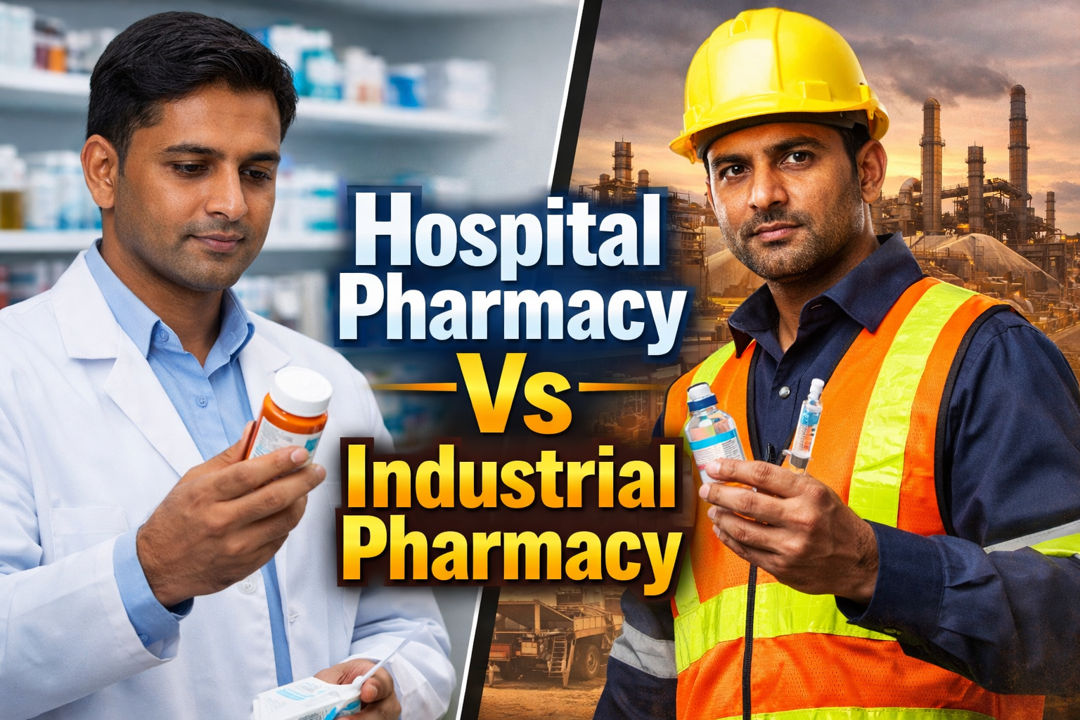
I’ve spent years working in and around occupational health centres—inside factories, mines, and large industrial plants—after being trained in the same pharmacy curriculum as everyone else. Early in my career, I used to hear people casually say, “Hospital pharmacy, industrial pharmacy—what’s the difference? Pharmacy is pharmacy.”
That assumption doesn’t last long once you actually start working inside an industrial setup.
On paper, both roles deal with medicines, storage, and compliance. In real life, they operate on completely different pressures. The environment, the expectations, and the consequences of mistakes are not the same. This piece isn’t theoretical. It’s shaped by long shifts, audits that came without warning, emergency calls at odd hours, and years of learning what really matters when you’re the only pharmacist responsible for an entire plant’s medical readiness.
The real difference: treating patients vs managing risk
In a hospital pharmacy, everything revolves around patients. Prescriptions flow in, doctors review cases, nurses follow protocols, and there’s always a clinical chain of command. Even when things go wrong, the system absorbs it—there are specialists, ICUs, diagnostics, and referral options within reach.
Industrial pharmacy works on a very different axis. Here, the core concern is not patient volume—it’s risk exposure.
Risk of accidents during operations.
Risk of chemical exposure.
Risk of non-availability during emergencies.
Risk of non-compliance during inspections.
You might have a quiet day with no medicine issued at all. And then, without warning, a serious incident happens—a fall from height, a chemical splash, a crushing injury. At that moment, no one asks how neatly your shelves are arranged. They ask one thing: Are we prepared?
That’s the fundamental shift. In an industrial setup, preparedness matters more than activity.
What a normal day actually looks like in an industrial pharmacy
People imagine pharmacists dispensing tablets all day. That image doesn’t hold here.
Most days, my work starts before the first medicine is issued. I look at temperature records first. Not because an auditor might ask—but because I’ve seen what power fluctuations can do to injectables during peak summer months.
Next comes emergency stock verification. Not a paper check. A physical one. Seals intact, quantities correct, no nearing-expiry surprises hiding at the back.
Only after that do I look at routine inventory.
Prescriptions are part of the job, yes—but they don’t define the day. Meetings with safety officers, discussions about new processes in the plant, reviews of chemical MSDS sheets, and planning for worst-case scenarios take up more mental space than dispensing ever will.
Some days I walk the plant floor just to check first-aid boxes. Some days I explain to non-medical managers why a certain injection cannot be stocked without proper cold-chain support. And occasionally, I spend hours preparing documentation that may never be read—unless something goes wrong.
That’s industrial pharmacy. Quiet when things are fine. Extremely visible when they aren’t.
Medicine selection: experience teaches restraint
This is one of the biggest adjustments pharmacists face when they move from hospitals to industries.
In hospitals, medicine selection is largely driven by consultants. Formularies are specialty-based. Brand preferences exist, and there’s room for therapeutic expansion.
In industrial health centres, that approach can backfire.
Here, medicine selection is guided by practicality and purpose, not preference.
I always start by asking:
What kind of injuries are realistically possible here?
What exposure risks exist?
How far is the nearest referral hospital?
How much time do these medicines need to buy us?
Painkillers are chosen carefully—not to mask symptoms but to allow safe transport. Antibiotics are kept limited, because without diagnostics and follow-up, overuse creates more problems than it solves.
Emergency medicines are selected because they stabilise, not because they “treat.” Adrenaline, antihistamines, steroids, bronchodilators—these are not negotiable in certain industries. But they must be justified, logged, and handled with discipline.
Every medicine in an industrial pharmacy must earn its place. If it doesn’t contribute to immediate safety or stabilisation, it usually doesn’t belong there.
Storage realities no textbook prepares you for
Most pharmacy textbooks describe ideal storage conditions. Industrial pharmacies deal with real ones.
Summer temperatures rise beyond comfort. Dust finds its way into places you didn’t think possible. Power supply fluctuates. Maintenance support isn’t always immediate, especially in remote plants.
I’ve seen refrigerators showing perfect readings on paper while the actual internal temperature was far from safe due to voltage issues. That’s when you realise logging alone isn’t enough. You need awareness, verification, and corrective action.
Cold-chain management becomes a daily responsibility, not a policy statement.
Emergency medicines need segregation—not just for access, but to prevent casual or accidental use. Near-expiry stock needs clear visibility, not just an Excel sheet reminder.
One overlooked ampoule can undo months of good work during an audit or emergency.
Emergency drug management: where theory meets reality
If there’s one area where industrial pharmacy shows its true weight, it’s emergency preparedness.
Emergency drugs aren’t “inventory.” They’re readiness tools.
In most plants, emergency kits are spread across multiple locations—plant floors, high-risk zones, ambulances, workshops. Managing them means standardisation, sealing, documentation, and relentless follow-up.
Whenever an emergency medicine is used—even for a minor incident—the kit must be restored immediately. I’ve replaced full trays late at night because partial readiness isn’t readiness at all.
Unlike hospitals, there’s no central crash cart team here. Often, it’s the pharmacist who ensures the system doesn’t fail quietly.
When an incident happens and everything works smoothly, no one remembers the pharmacy. But if something is missing, everyone notices.
Documentation: not optional, not decorative
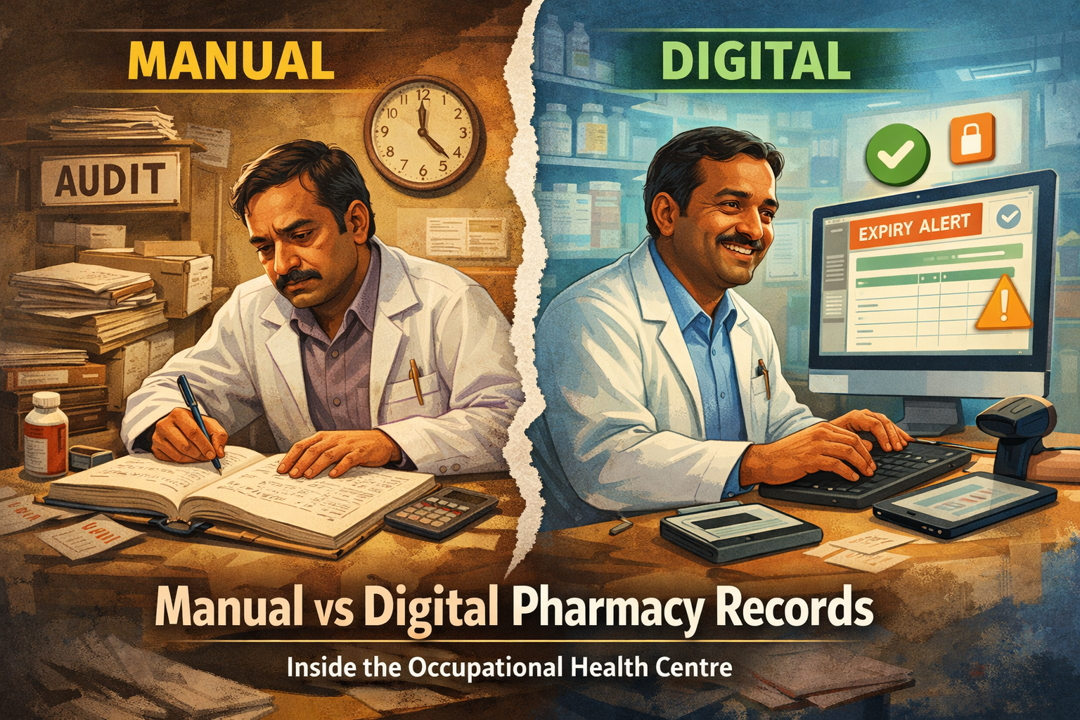
In industrial pharmacy, documentation is your strongest defence.
It’s not about how many medicines you issued. It’s about how clearly you can explain why you stocked something, how you maintained it, and when corrective action was taken.
Auditors don’t ask theoretical questions. They ask for proof.
Temperature deviations. Expiry handling. Emergency usage justification. Indent approvals. Incident-linked medicine consumption.
If your records tell a logical story, audits remain professional. If they don’t, they become uncomfortable very quickly.
Over time, you learn to document not for compliance alone, but for clarity—so that even someone unfamiliar with your setup can understand your decisions.
Compliance pressure: always present, rarely visible
Industrial pharmacies operate under multiple layers of scrutiny—statutory requirements, company policies, safety standards, sometimes even international frameworks.
Unlike hospitals, where audits are largely clinical, here they’re procedural and legal.
A missing register entry might not harm a patient, but it can raise serious questions about system integrity.
The pharmacist often becomes the bridge between medical logic and regulatory language. That responsibility isn’t always acknowledged, but it’s critical.
Where new pharmacists usually struggle
Most mistakes I’ve seen aren’t due to lack of knowledge. They’re due to mindset.
New pharmacists often:
- Over-stock medicines “just in case”
- Depend entirely on doctors for decisions
- Underestimate emergency preparedness
- Treat documentation as secondary work
- Avoid plant exposure
- Delay expiry replacement thinking usage is rare
Industrial pharmacy doesn’t reward passivity. It requires involvement, foresight, and the confidence to say no—with reasons.
The moment you treat this role like a hospital store, problems start appearing.
Living the difference: hospital vs industrial pharmacy
Hospital pharmacy is clinically demanding. Industrial pharmacy is operationally demanding.
Hospitals deal with complexity of disease. Industries deal with unpredictability of events.
Hospital pharmacy supports patient care. Industrial pharmacy supports system safety.
Both are essential. Both require skill. But they shape professionals differently.
In industries, you learn to think beyond prescriptions. You start seeing pharmacy as part of a safety ecosystem, not a dispensing unit.
What this role does to you as a professional
Industrial pharmacy teaches restraint, accountability, and anticipation.
You stop reacting and start preparing.
You stop chasing brands and start respecting protocols.
You learn to justify decisions in rooms full of non-medical professionals.
It’s not glamorous work. There are no applause moments. But when a serious incident is handled smoothly because systems were ready—that quiet success stays with you.