A Practical View from Occupational Health Centres in India
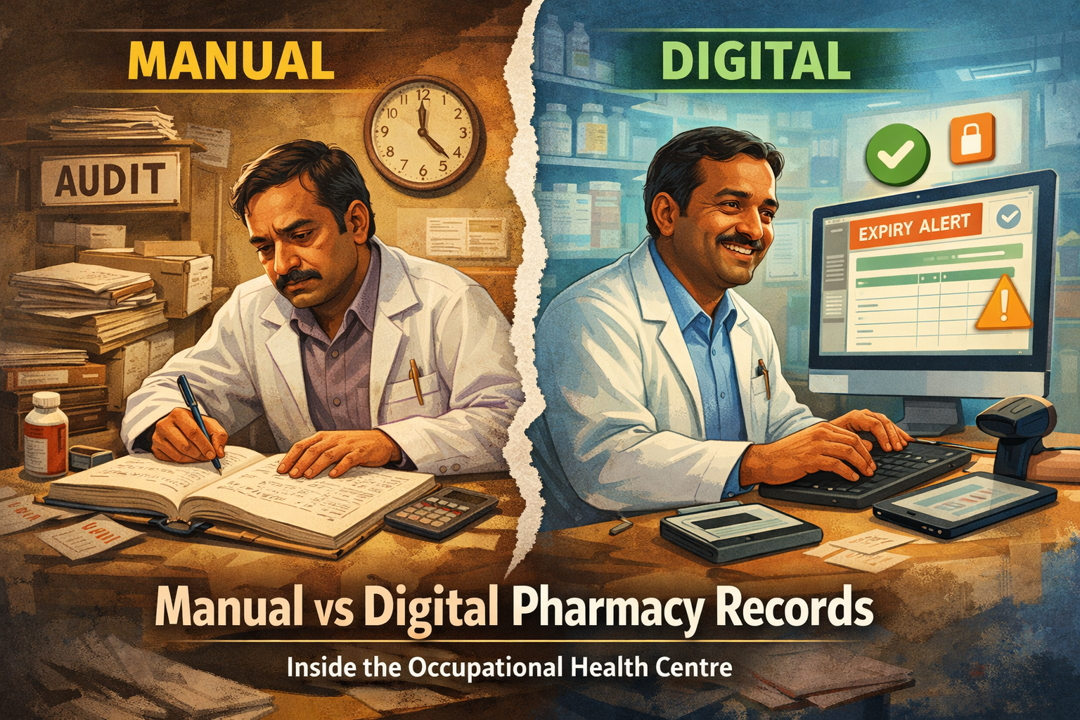
I started my career when manual registers were the backbone of every OHC pharmacy. Thick stock registers. Issue registers signed with carbon pens. Indents handwritten, photocopied, and carried to the admin office. At that time, it felt normal. Nobody questioned it.
Nine years later, after working across manufacturing plants, project sites, and corporate OHCs, I can say this clearly:
Manual pharmacy records don’t fail suddenly. They fail silently.
You don’t notice the cracks until an audit comes, a serious incident happens, or management asks a simple question you can’t answer with confidence.
This article is not about selling software.
It’s about what actually works inside Indian Occupational Health Centres, where constraints are real—limited staff, mixed-shift operations, regulatory pressure, and cost sensitivity.
Why Manual Systems Still Exist in OHCs
Before criticizing manual records, we need to acknowledge why they are still widely used.
Most OHC pharmacies in India are not standalone hospitals. They are support systems inside factories, mines, power plants, and infrastructure sites. Pharmacy is often seen as a cost centre, not a value centre.
Common realities:
- One pharmacist managing OPD, emergency stock, reports, and store
- Doctors rotating on contract
- Management focused on production, not pharmacy operations
- “It’s working fine” mindset
Manual systems survive because:
- They are familiar
- They don’t require upfront cost
- Auditors historically accepted them
But familiarity is not reliability.
The Real Problems with Manual Pharmacy Records (Beyond the Obvious)
Everyone knows manual records are “slow” or “messy.” That’s not the real issue. The deeper problems show up only if you’ve lived inside an OHC.
1. Stock Visibility Is Always Retrospective
Manual registers tell you what happened, not what is happening.
You realize:
- Critical emergency drug is near expiry only during monthly checking
- A fast-moving item went out of stock only after the doctor asks for it
- Night shift consumption never matches day shift entries
In one plant, we discovered during audit that adrenaline ampoules had expired three months earlier, even though entries showed regular checking. On paper, everything was perfect. On ground, it wasn’t.
2. Indent Planning Becomes Guesswork
Manual consumption data is rarely clean.
Issues:
- Different handwriting styles
- Incomplete entries
- Corrections without initials
- Medicines issued but not recorded during emergencies
So when management asks:
“Why are you asking more stock this quarter?”
The honest answer is:
“Based on experience.”
That doesn’t inspire confidence.
3. Audit Stress Is Unnecessarily High
Anyone who has faced internal, external, or statutory audits knows this pain.
Before audit:
- Registers suddenly get rewritten
- Expiry lists are rushed
- Cross-checking takes days
- Staff panic increases error probability
Auditors don’t just check records.
They check consistency, traceability, and control.
Manual systems make you defend your integrity instead of demonstrating it.
4. Incident Review Is Weak
When a medical incident occurs—needle stick injury, chemical exposure, cardiac emergency—records matter.
Manual systems make it difficult to answer:
- What exact drug was issued?
- Who issued it?
- Was it within expiry?
- Was protocol followed?
In high-risk industries, this is not a small gap. It’s a liability.
5. Knowledge Leaves When People Leave
This is rarely discussed.
In manual systems:
- Stock logic lives in the pharmacist’s head
- Reorder points are “understood”, not documented
- Vendor follow-ups depend on personal rapport
When an experienced pharmacist leaves, the system collapses for months.
Why Digital Pharmacy Records Make Sense in OHCs (When Done Right)
Digital does not automatically mean better.
But well-designed digital systems fix problems manual systems cannot.
Real Benefit #1: Live Stock Control, Not End-Month Surprises
Digital records give you:
- Real-time stock visibility
- Batch-wise expiry alerts
- Minimum stock warnings
This alone reduces:
- Emergency purchases
- Expired stock write-offs
- Doctor dissatisfaction
In one OHC, simply enabling expiry alerts reduced wastage by over 40% in a year—without increasing budget.
Real Benefit #2: Data-Backed Conversations with Management
Instead of saying:
“We need more budget”
You can say:
“Respiratory cases increased 22% during monsoon; bronchodilator consumption rose accordingly.”
Management listens when data speaks.
Real Benefit #3: Cleaner Audits with Less Stress
Audits become:
- Faster
- More transparent
- Less confrontational
Instead of flipping pages, you generate:
- Stock summary
- Issue logs
- Expiry reports
Auditors may still ask questions, but now you have answers, not explanations.
Real Benefit #4: Continuity Across Staff Changes
Digital systems reduce dependency on individual memory.
A new pharmacist can understand:
- Consumption patterns
- Vendor cycles
- Critical stock list
That stability matters in contract-heavy OHC environments.
Features That Actually Matter (And Many That Don’t)
Most pharmacy software demos look impressive.
But OHCs don’t need hospital-grade complexity.
What Truly Matters
Simple, fast medicine issue workflow
OHC OPDs are busy. If data entry slows down patient flow, staff will bypass the system.
Batch & expiry tracking
Non-negotiable for emergency medicines.
Minimum stock & reorder alerts
This alone saves hours of mental tracking.
Doctor-wise or department-wise consumption
Helps in trend analysis and reporting.
Exportable reports (Excel/PDF)
Because management still loves Excel.
Offline or low-internet capability
Many plant locations have unstable connectivity.
What Usually Doesn’t Matter in OHC Context
- Fancy billing modules
- Insurance integration
- Complex patient EMR workflows
- Over-customized dashboards nobody uses
OHC pharmacy software should be boring, fast, and reliable.
Data Privacy & Compliance: Indian Reality Check
Digital adoption brings responsibility.
In India, healthcare data protection is evolving. While enforcement may feel light today, expect scrutiny to increase.
Key practical principles OHCs must follow:
1. Access Control Is Critical
Not everyone needs access to everything.
- Pharmacist: full stock access
- Doctor: prescription view
- Admin: summary reports
Shared passwords are a disaster waiting to happen.
2. Local Data Hosting Awareness
Many companies prefer:
- On-premise systems
- India-hosted servers
This is often driven by internal IT policies, not law—but must be respected.
3. Audit Logs Matter
A good system should track:
- Who edited what
- When it was edited
This protects staff as much as management.
4. Don’t Digitize Chaos
Uploading inaccurate manual data into a digital system does not make it clean.
Data discipline must change along with tools.
Common Tech Mistakes Made by Management (Seen Repeatedly)
Mistake 1: Buying Software Without Involving Pharmacists
This is the biggest one.
Software selected by:
- IT team alone
- Admin alone
- Procurement alone
Result?
Pharmacists find workarounds. Data quality drops. System “fails”.
Mistake 2: Expecting Instant Perfection
Digital transition takes:
- 1–2 months of adjustment
- Parallel manual + digital phase
- Training patience
Declaring failure in two weeks is unfair.
Mistake 3: Over-Customization
Custom fields, workflows, approvals—everything added at once.
Simple systems scale. Complicated ones break.
Mistake 4: Ignoring Change Fatigue
Staff already handle:
- Medical emergencies
- Compliance
- Long shifts
Digital tools must reduce workload, not add to it.
A Practical Step-by-Step Digital Adoption Roadmap for OHCs
This is what works on the ground.
Step 1: Clean Your Manual Data First
Before any software:
- Verify current stock physically
- Dispose expired items properly
- Standardize medicine names
This sets the foundation.
Step 2: Start with Inventory, Not OPD
Begin digitalization with:
- Stock entry
- Issue recording
- Expiry tracking
OPD notes can come later.
Step 3: Run Parallel Systems (Temporarily)
For 1–2 months:
- Maintain manual register
- Use digital system daily
Compare discrepancies. Fix habits.
Step 4: Train with Real Scenarios
Training should cover:
- Emergency issue
- Night shift handover
- Audit day reporting
Not just demo data.
Step 5: Freeze Workflows Early
Avoid frequent changes in:
- Medicine naming
- Issue process
- Report formats
Stability builds confidence.
Step 6: Review Monthly, Improve Quarterly
Don’t micromanage daily.
Monthly review:
- Stock variance
- Expiry trends
- Usage patterns
Quarterly improvements are enough.
Final Thoughts: Digital Is Not About Technology
Digital pharmacy records are not about impressing auditors or management.
They are about:
- Safer patient care
- Less mental load on pharmacists
- Predictable operations
- Institutional memory
Manual systems rely on good people.
Digital systems support good processes.
In Occupational Health Centres—where one missed detail can escalate into a serious incident—process support matters.
Adopt digital tools not because they are modern, but because they make healthcare delivery more reliable, more transparent, and more humane.
And remember:
A calm pharmacist with clear data is far more valuable than the fanciest software no one trusts.