A ground‑level perspective from Indian workplaces
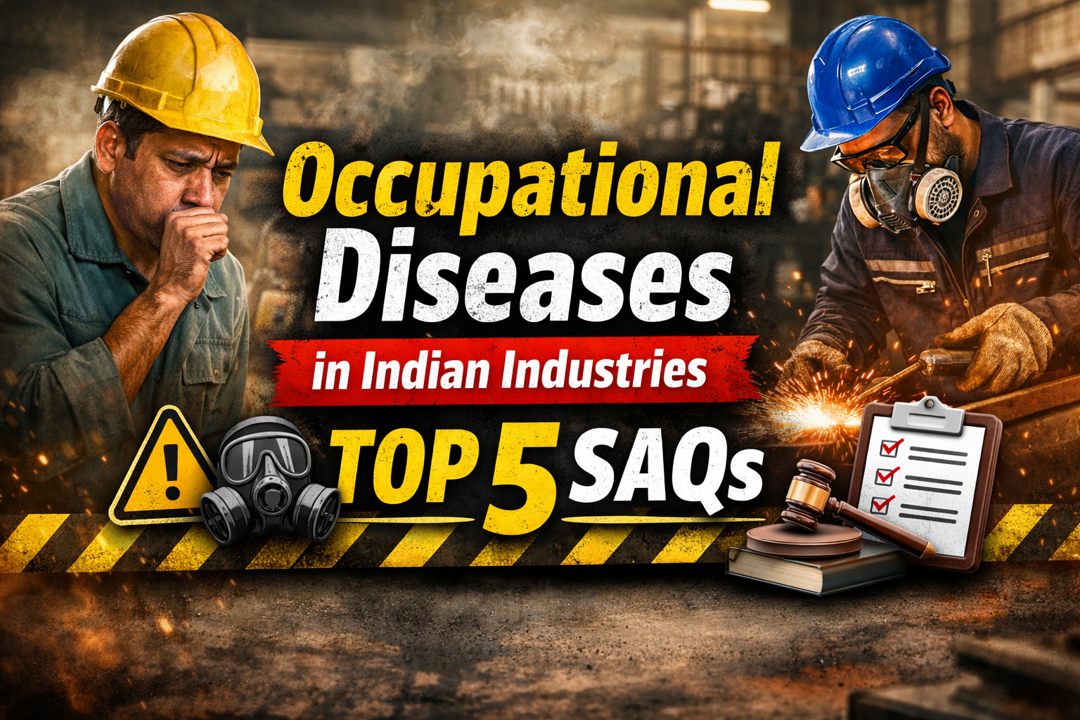
When people hear the term occupational disease, many imagine rare illnesses seen only in mines or chemical factories. That picture is far from reality. In Indian industries, occupational diseases develop quietly in everyday workplaces — manufacturing units, warehouses, power plants, construction sites, pharma facilities, smelters, logistics yards, and even well‑lit, air‑conditioned offices.
What makes these diseases dangerous is not just the hazard itself, but how easily it blends into routine work. Workers adjust. Supervisors focus on output. Medical check‑ups become a yearly formality. By the time a problem is formally diagnosed, the damage is usually already done — to the worker’s health, the team’s efficiency, and sometimes the company’s compliance record.
This article is written from the perspective of Indian shop floors and OHCs, not from textbooks. It is meant for workers, safety managers, HR professionals, and occupational health staff who deal with real targets, real pressure, and real people every day.
How occupational diseases actually develop in workplaces
In most Indian industries, occupational diseases do not begin with a single major exposure. They develop slowly, almost invisibly, through repeated low‑level exposure combined with delayed attention.
A worker inhales fine dust daily. A technician handles solvents without gloves because the task is “just for two minutes.” A fitter spends years in high‑noise areas. A forklift operator sits through long shifts with constant vibration passing through the body. None of this feels serious at the beginning.
The problem is cumulative exposure.
I have seen workers feel perfectly normal for five or even seven years, and then suddenly start complaining of breathlessness, joint pain, hearing difficulty, numbness in fingers, or recurring skin issues. By the time these symptoms are taken seriously, the disease process has often crossed the reversible stage.
In Indian workplaces, three factors speed this up:
Long working hours and overtime. Irregular or incorrect use of PPE. Limited understanding of long‑term health risks.
Add to this the familiar attitude of “adjust ho jayega,” and you have the ideal environment for occupational disease to grow quietly.
Common occupational diseases seen in Indian industries
Instead of listing medical terms, it is more useful to look at what actually appears in OHC registers and daily complaints.
Dust‑related lung problems
In cement plants, mines, stone‑crushing units, and bulk material handling areas, fine dust is unavoidable. Workers initially report mild cough, chest tightness, or breathlessness during exertion.
Most dismiss it. Coughing is considered part of the job. Over time, lung capacity reduces, chest infections become frequent, and stamina drops. By then, recovery becomes difficult.
Noise‑induced hearing loss
In power plants, rolling mills, heavy engineering workshops, and DG rooms, noise is constant. Workers adapt by shouting louder or ignoring the ringing in their ears.
When audiometry finally shows hearing loss, it is usually permanent. Many realise it only when they struggle to hear instructions at home or on the shop floor.
Musculoskeletal disorders
This is one of the most underestimated occupational health problems in India.
Back pain in loaders and warehouse staff. Shoulder and wrist pain in machine operators. Knee problems in construction workers. Neck strain in control rooms and offices.
These are often brushed off as age‑related or personal issues. In reality, years of poor posture, repetitive work, manual handling, and long shifts are the root cause.
Skin diseases
In pharma units, chemical plants, paint shops, and maintenance activities, skin exposure is common. What starts as mild itching often becomes chronic dermatitis when gloves are avoided, reused, or worn incorrectly.
Once skin sensitivity develops, even minimal exposure can trigger severe reactions, forcing job changes.
Heat‑related illnesses
Indian summers add a unique challenge. Foundries, boiler areas, kilns, and outdoor construction sites quickly turn into high‑risk zones. Dehydration, heat cramps, and exhaustion are frequently reported but rarely documented seriously.
Repeated heat stress affects not just comfort but kidneys, concentration, and long‑term work capacity.
Chemical exposure effects
Solvents, fumes, gases, and vapours are part of many routine processes. Early symptoms include headache, dizziness, eye irritation, and unexplained fatigue.
These complaints are often ignored or treated casually, while the exposure continues in the background.
Real industrial exposure examples from Indian sites
These are situations I have personally encountered across Indian industries.
A contract worker in a smelter unit worked near pot rooms for six years. He frequently complained of fatigue and joint pain. Periodic medicals were conducted, but reports were never reviewed beyond signatures. The occupational link was recognised very late.
A warehouse helper developed chronic back pain after years of manual lifting. Instead of job rotation or ergonomic correction, he was repeatedly given rest and painkillers. Eventually, he became medically unfit for heavy work.
In a pharma facility, operators reused nitrile gloves across multiple shifts to save time during batch changeovers. Within a year, several workers developed contact dermatitis.
At a construction site, workers avoided helmets and ear protection during peak summer hours. Headaches and hearing complaints became common, but no structured follow‑up was done.
These are not rare incidents. They are everyday realities across Indian industries.
Early warning signs workers commonly ignore
One of the biggest gaps in occupational health is failure to act on early signals.
Workers often walk into the OHC saying:
“Thoda sa saans phoolta hai.” “Kaam ke baad body pain hota hai.” “Kaan mein awaaz aati rehti hai.” “Skin thodi sensitive ho gayi hai.”
These are not casual complaints. They are early warning signs. Yet they are often treated symptomatically rather than occupationally.
Painkillers, cough syrups, antacids, or vitamins may provide short‑term relief, but exposure continues unchanged. Real prevention begins with listening carefully and linking symptoms to the workplace.
Role of the Occupational Health Centre (OHC) in detection and prevention
An OHC should never function only as a first‑aid room. Its true role is preventive.
Effective OHCs in Indian industries focus on exposure‑based surveillance, trend analysis, and close coordination with safety and HR teams.
Periodic medical examinations must go beyond ticking boxes. Audiometry, spirometry, vision tests, and lab results need to be interpreted against specific job roles and departments.
When multiple workers from the same area show similar complaints, it is rarely coincidence. It is a pattern.
Regular shop‑floor visits by OHC staff make a big difference. Many issues surface during informal conversations outside the clinic.
Legal responsibilities of employers in India
Indian labour laws clearly place responsibility on employers to protect workers from occupational diseases.
The Factories Act, 1948 and related state rules mandate safe working conditions, periodic health examinations, disease notification, and provision of appropriate PPE and training.
Non‑compliance can lead to compensation claims, regulatory penalties, and reputational damage.
From experience, compliance works best when it is treated as a responsibility, not just a legal requirement.
Preventive measures that actually work on Indian shop floors
Prevention does not always require expensive systems. Simple, consistent actions matter most.
Engineering controls such as dust extraction, noise enclosures, and proper ventilation should always be the first line of defence.
PPE is effective only when it is comfortable, suitable for Indian weather, and workers understand its purpose.
Job rotation helps reduce cumulative exposure, especially for repetitive or physically demanding tasks.
Adequate hydration, shaded rest areas, and electrolyte support significantly reduce heat‑related problems.
Most importantly, safety and health training must be continuous, not limited to induction programs.
Long‑term impact on productivity and compliance
Occupational diseases affect far more than individual health.
Chronic illness leads to absenteeism, reduced efficiency, increased medical costs, and loss of experienced manpower. Replacement and retraining take time and money.
From a compliance perspective, weak occupational health systems raise concerns during audits and inspections.
Industries that invest consistently in prevention see better morale, lower health‑related attrition, and smoother regulatory interactions.
Closing thoughts from the field
Occupational diseases are not unavoidable. Most are preventable.
What is needed is not more paperwork, but stronger awareness, ownership, and practical action.
Workers must feel safe to report early symptoms. Supervisors need to observe honestly. OHC teams must move beyond routine check‑ups. Management should view occupational health as a long‑term investment, not a cost.
In Indian industries, when worker health is protected, productivity follows naturally. That is not theory. It is something I have seen repeatedly on the ground.